A small companion · standard Wolfram encoding
Three bits.
Four futures.
Elementary cellular automata make the rule visible. One cell reads its left, center, and right neighbors; an eight-row lookup table decides the next color. This atlas lets Rule 110, its color-conjugate Rule 137, Rule 42, and Rule 30 share one honest control surface.
index = 4 × left + 2 × center + right
output = (rule >> index) & 1
output = (rule >> index) & 1
64 cells · standard seedsame encoding · many worlds
01 / Controlled replay
Change the rule. Keep the question fixed.
Choose a rule, width, boundary, and outside background. The selected single board is independent; the paired 110 / 137 boards below are a separate exact color-conjugacy check.
Rule
Width
Boundary
Outside background
Rule 110 · width 64 · wrap · background 0single seed / generation 0
- Rule
- 110
- Generation
- 0
- Live cells
- 1
- Boundary
- wrap
- Mapped pair
- exact
02 / Exact relation
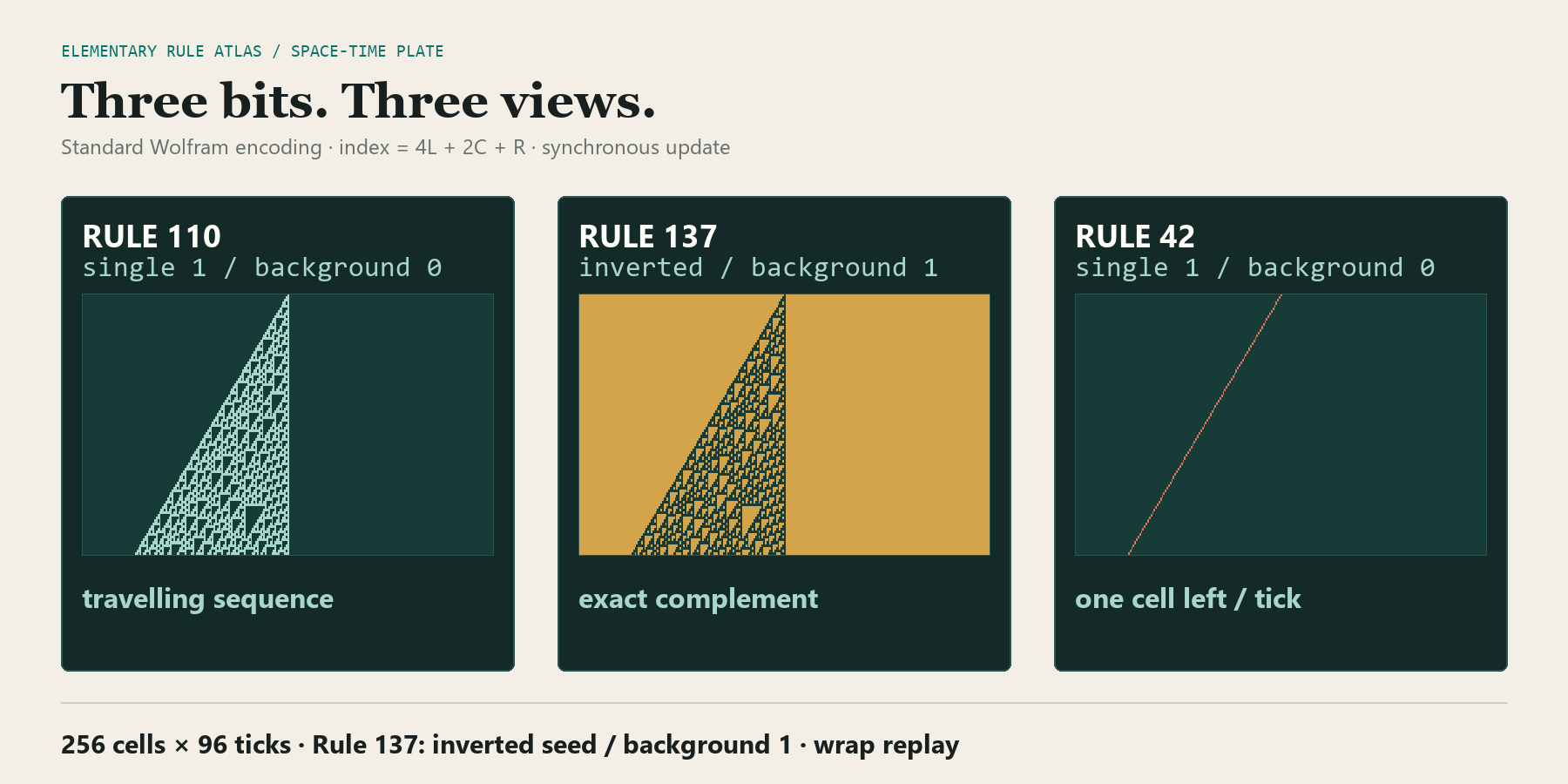
Rule 137 is Rule 110 in mirror colors.
For every local neighborhood, F137(1 − x) = 1 − F110(x). The paired boards begin as complements, use outside backgrounds 0 and 1, and step together at every tick.
Rule 137state 1 - x · background 1
Checking exact complement relation…Every tick compares Rule 137 to the complement of Rule 110.
03 / Eight local cases
Tables before adjectives.
Each card is the complete eight-input rule table. The shared index is explicit so the visual replay can be checked against the arithmetic.
Color conjugacy is a relation, not a benchmark. Rule 110 / 137 pass an exact mapped-state check by construction. Rule 42 and Rule 30 are shown as independent tables; this page makes no universality, computational-class, or biological claim about either one.
04 / Proof gates
Small tests, visible receipts.
The page runs deterministic checks on load: all eight table rows, the 110 / 137 relation, and random boards at both widths across wrap and dead boundaries.
42
A tiny wink to the number, then back to the table. Rule 42 is included for comparison; this atlas makes no universality claim.