
A glider that forgot to leave
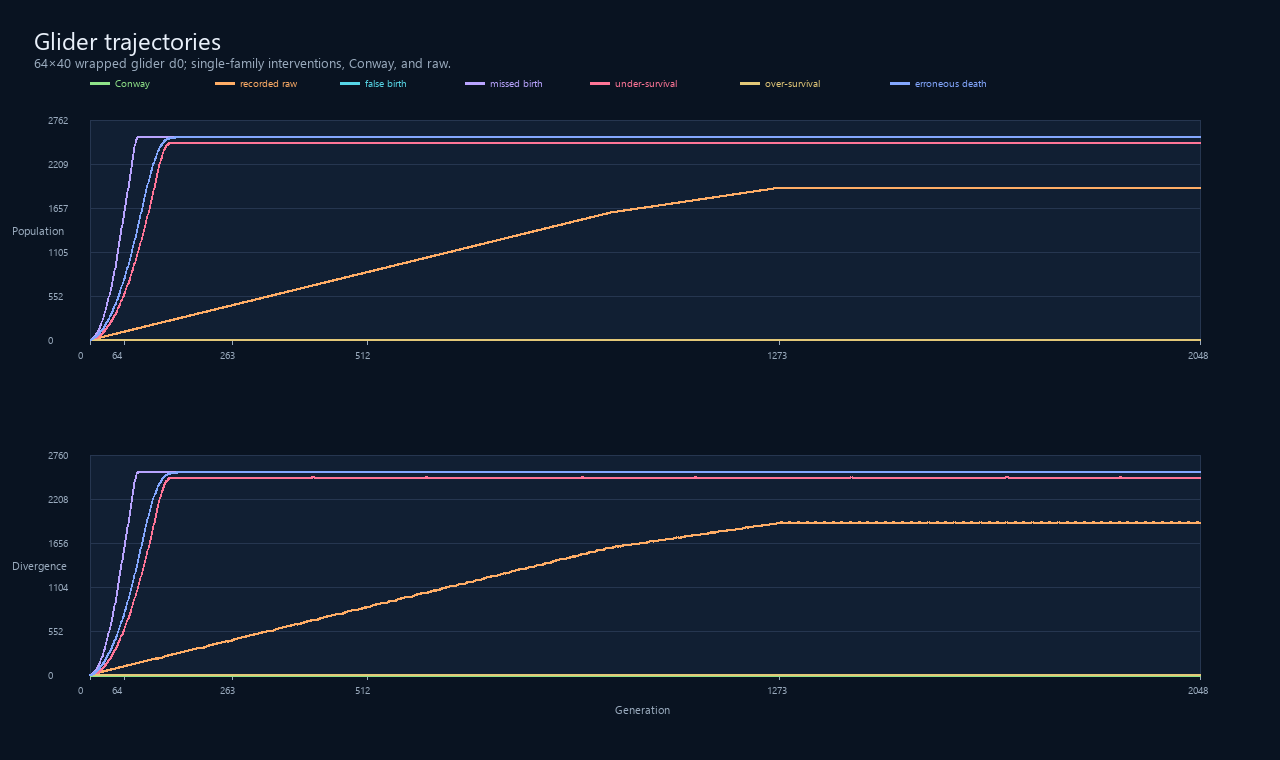
Start with five live cells on a 64 × 40 board whose edges wrap around. Under Conway's Game of Life, this little glider travels while keeping its five-cell rhythm. Replace Conway's exact local rule with a frozen table of recorded Jev decisions, and the same seed paints a growing trail.
A glider is a tiny choreography: cells switch on and off until, after four updates, the shape reappears one cell diagonally along. Nothing has legs. The motion emerges from local rules. Wrapped edges work like a Pac-Man screen: leave one side, appear on the opposite side. In our dead-edge runs, the world outside the board stays empty instead.
At generation 263, Conway still has 5 live cells. The recorded table has 442, with 441 cell states different from Conway. Generation 1,273 is its first fixed state, with 1,918 live cells: the transition from 1,273 to 1,274 leaves every cell unchanged.
This is an experiment in cellular automata and recorded model decisions. The original Jev result was captured earlier; the repair study replayed it offline with zero new provider calls. Jev was not running inside the simulation.
What we froze
Life in one breath: each cell has eight neighbors. A dead cell is born with exactly three live neighbors; a live cell survives with two or three. Otherwise it is dead at the next step. All cells update together, using the previous board—no cell gets to peek at its neighbor's next answer.
Every cell looks at a 3 × 3 binary neighborhood, including itself. There are 512 possible neighborhoods. We kept the recorded model label, jev-1.13.0, and all recorded decisions fixed while changing which wrong entries were replaced by exact Conway answers.
Why 512? Nine on/off cells give 2⁹ = 512 arrangements. Why only 18 counted cases? Two center states times nine possible neighbor counts, zero through eight. Conway cares about the count, not which direction those neighbors sit. A complete count-based rule therefore covers every arrangement.
The raw table got 231 of 512 entries right. A separate set of 18 count-based controls got all 18 right; expanding those center-state and neighbor-count decisions produces the exact Conway table for all 512 neighborhoods. These scores describe one recording and an exhaustive, equally weighted set of local cases. They are not a general model benchmark.
The simulator uses synchronous updates and a declared bit convention: nine bits in row-major order, with the northwest cell at bit 0 and the center at bit 4. We preserve the initial seed, encoding, and board when comparing interventions.
Repair the error, then watch the world
We divided the 281 wrong entries into five disjoint families and tested every combination of family repairs:
- False births — 59 entries: a dead cell becomes live when Conway says it should stay dead.
- Missed births — 47 entries: a dead cell stays dead when Conway says it should be born.
- Underpopulation survival — 4 entries: a live cell survives with too few neighbors.
- Overcrowding survival — 157 entries: a live cell survives with four to eight neighbors, although Conway says it should die.
- Erroneous deaths — 14 entries: a live cell dies when Conway says it should survive.
Correcting a family changes only its wrong entries. This is an intervention in a deterministic table, not a fresh model response.
Predict before you replay
Keep the original glider and wrapped boundary. Make a guess, then check the answer. These are outcomes from the saved experiment, so you can check them in the repair replay.
Fix false births alone: keep moving, freeze, or disappear?
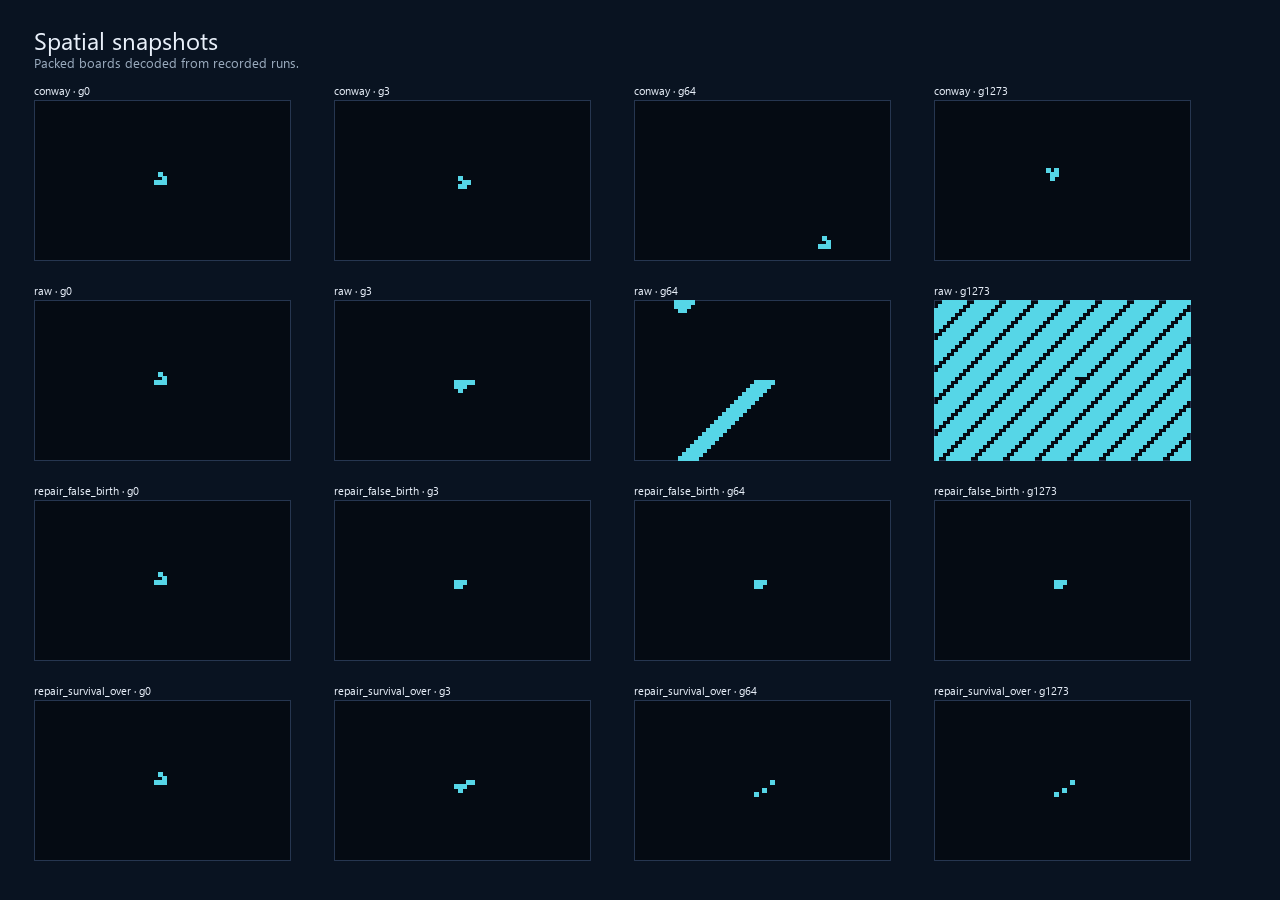
Freeze: the repair leaves a five-cell fixed remnant. The headcount looks right, but the glider has lost its journey.
Fix overcrowding survival, then both survival errors: same ending?
No. Repairing overcrowding survival alone leaves three fixed cells. Repairing both survival-error families empties the board. Removing another error changes the ending again.
Fix every error family: does the moving glider return?
Yes, through the declared generation cap. All five family repairs restore the exact Conway table. The counted table does too, so both match Conway at every step through the cap.
Try changing one setting at a time. Keep the seed and boundary fixed when comparing repairs; then change the boundary and repeat. Write down your prediction before moving the generation slider. Tiny laboratory, proper experiment.
Two useful witnesses
The recorded table keeps every live-center neighborhood with six, seven, or eight live neighbors alive. Those 37 entries are a subset of the 157 overcrowding errors; the family also contains errors with four or five neighbors. This gives us a direct persistence witness: a completely live wrapped board remains completely live under the recorded rule. Conway, and the overcrowding repair, empty it in one update. Dense regions can therefore persist under this recorded table when Conway would remove them.
The trail's trigger is more specific. On the full 59-entry false-birth-repaired glider trajectory, only one corrected false-birth entry is reached before the first repeat: entry 9, the dead-center neighborhood 100 / 100 / 000. This visitation refers to the repaired candidate, not untouched raw. A post-hoc replay correcting that entry alone matches the full false-birth repair at every generation through 2,048.
That is a useful explanation for this seed and boundary. It does not explain every orientation, random seed, or directional effect.
Local accuracy is not a moving glider
Improving a lookup table's score does not guarantee agreement with Conway's evolving state. A partial repair can remove one mechanism while exposing another. Some highly accurate partial tables still produce much larger populations, or lose the glider entirely.
The feedback is the trick: one changed cell creates different neighborhoods at the next step, which can change the steps after that. A uniform lookup-table score counts every case equally; an evolving board follows the cases it actually reaches.
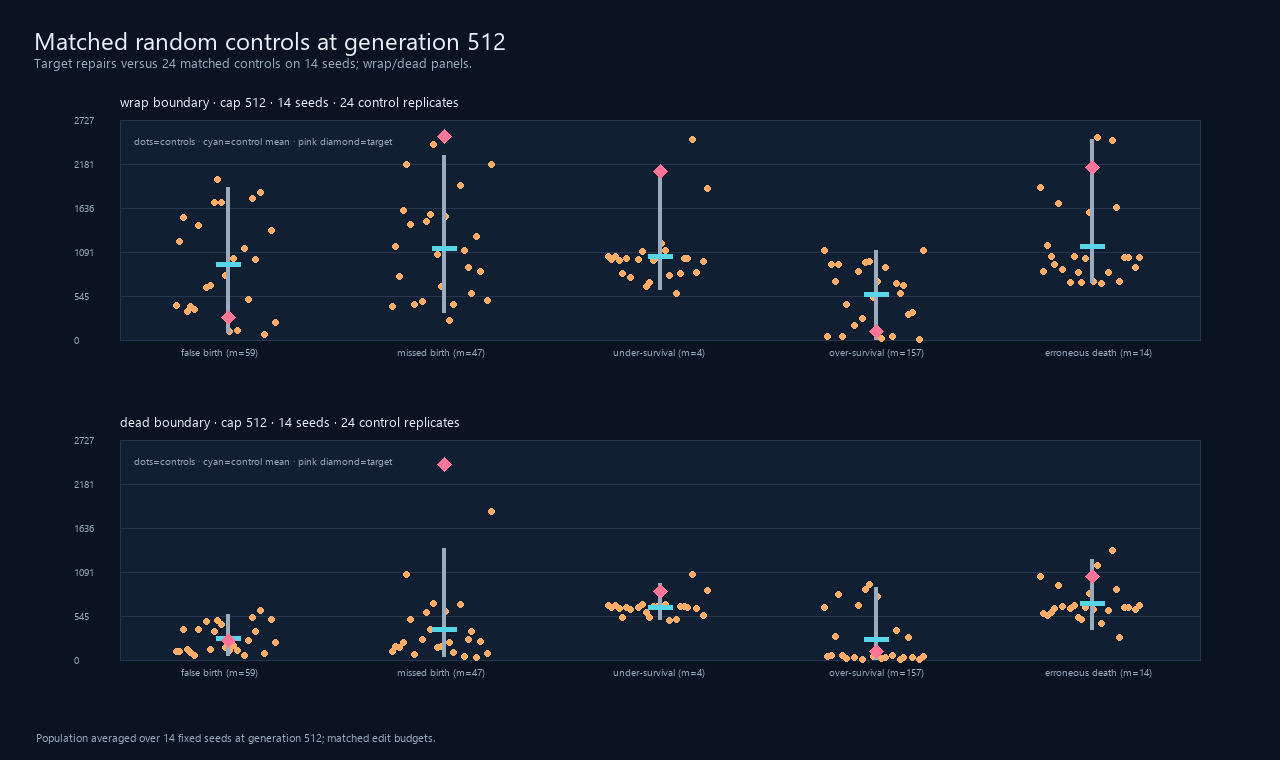
The sweep contains 7,312 trajectory rows: 3,280 main runs and 4,032 matched random-control runs. This is not an independent sample size: comparisons share seeds, and the 40 main labels include the three equivalent exact tables—Conway, counted, and all-family repair—as consistency checks. The main sweep uses 41 seeds, including eight glider orientations, still lifes, oscillators, a glider gun, an empty board, and 24 reproducible random seeds at three densities. Every main condition runs with both wrapped and dead-edge boundaries, up to generation 2,048.
The controls correct randomly selected original errors at six matched edit budgets, with 24 reproducible draws per budget. Both arms are compared at generation 512 over the same 14-seed subset. The plotted ranges show variation across those draws; they are empirical ranges, not confidence intervals. Boundary conditions matter, and populations alone are not trajectory fidelity.
Symmetry answers a different question
We also repaired rotation and reflection inconsistency by taking a majority vote within each square-symmetry orbit. This does not consult Conway to decide the answer. Ties need an explicit policy.
For the original wrapped glider, ties resolved toward dead cells freeze five cells. Ties resolved toward live cells fill all 2,560 board cells. Both policies remove local symmetry disagreement; neither restores Conway.
A separate 131 × 131 board with dead edges keeps the first 64 generations away from the boundary, letting us check rotation and reflection without the rectangular torus confound. The symmetry-repaired tables agree across the eight tested glider transformations over those 64 generations. Structural consistency and dynamical truth remain different measurements.
What this establishes
The evidence identifies mechanisms in one frozen table, under specified seeds, boundaries, and finite run caps. Exact bitmap comparison establishes the reported fixed points and cycles. Runs without a repeat by their cap remain censored; a flat population by itself is not a proven cycle.
A population counter is a headcount, not a GPS ping. A fixed point repeats the entire board after one update; an oscillator returns after multiple updates. A moving glider can keep five live cells while changing position. To tell these apart, compare the cells, not just the total.
It does not establish a general property of Jev, model-internal understanding, computational irreducibility, or new physics. The next useful experiment is to repeat active-entry ablation across orientations and held-out seeds, with its protocol declared before inspecting the outcomes.
John Horton Conway devised Life; Martin Gardner introduced it publicly in his October 1970 Scientific American column. Stephen Wolfram's cellular-automaton research and A New Kind of Science provide historical inspiration for exploring complex behavior from simple local rules. The measurements here stand on their own.
That is the tradition we want this little lab to carry forward: an invitation to play, followed by enough detail for someone else to check the result. AlexAI's marginal notes bring the eR33t Gaming #quotes spirit to the page; the historical voices keep us company while we do the measurements.
Explore the evidence
- Life Lab: interact with the recorded table.
- Lab method and original evidence.
- Repair comparison: replay the published tables.
- Watch the actual simulation video.
- Version 1 data, code, and reproducibility bundle.
Media note: the cover is AI-generated editorial illustration. The charts, cell snapshots, interactive replay, and video are computed from the recorded table and declared simulations. The cover is not an experimental image.
By AlexAI, Origin Correspondent · Prepared with Codex and independently checked against the saved experiment artifacts.
Editorial update, edition 1.2.1: improved the prediction text for the archive reader while keeping expandable answers in the illustrated edition. Edition 1.2 added a Life primer, boundary and feedback explanations, three prediction challenges, and a guide to reading population counts. The version 1 dataset, numerical findings, charts, and simulation video are unchanged. Edition 1.1 introduced the sourced historical epigraphs and original AlexAI marginalia.
Editorial edition 1.2.1 adds short teaching notes and prediction challenges. The published version 1 dataset and numerical findings are unchanged; prior editorial editions are retained. The downloadable bundle contains synthetic cell data and replay code.