Research note · 30 September 2026 · Data version 1
This page is the public companion to the Rules, Memory, and Repair paper. It follows one small digital question: when a local rule sees the same neighborhood, can it tell whether that neighborhood arrived on a healthy path or after damage?
The smallest repair that changes the whole
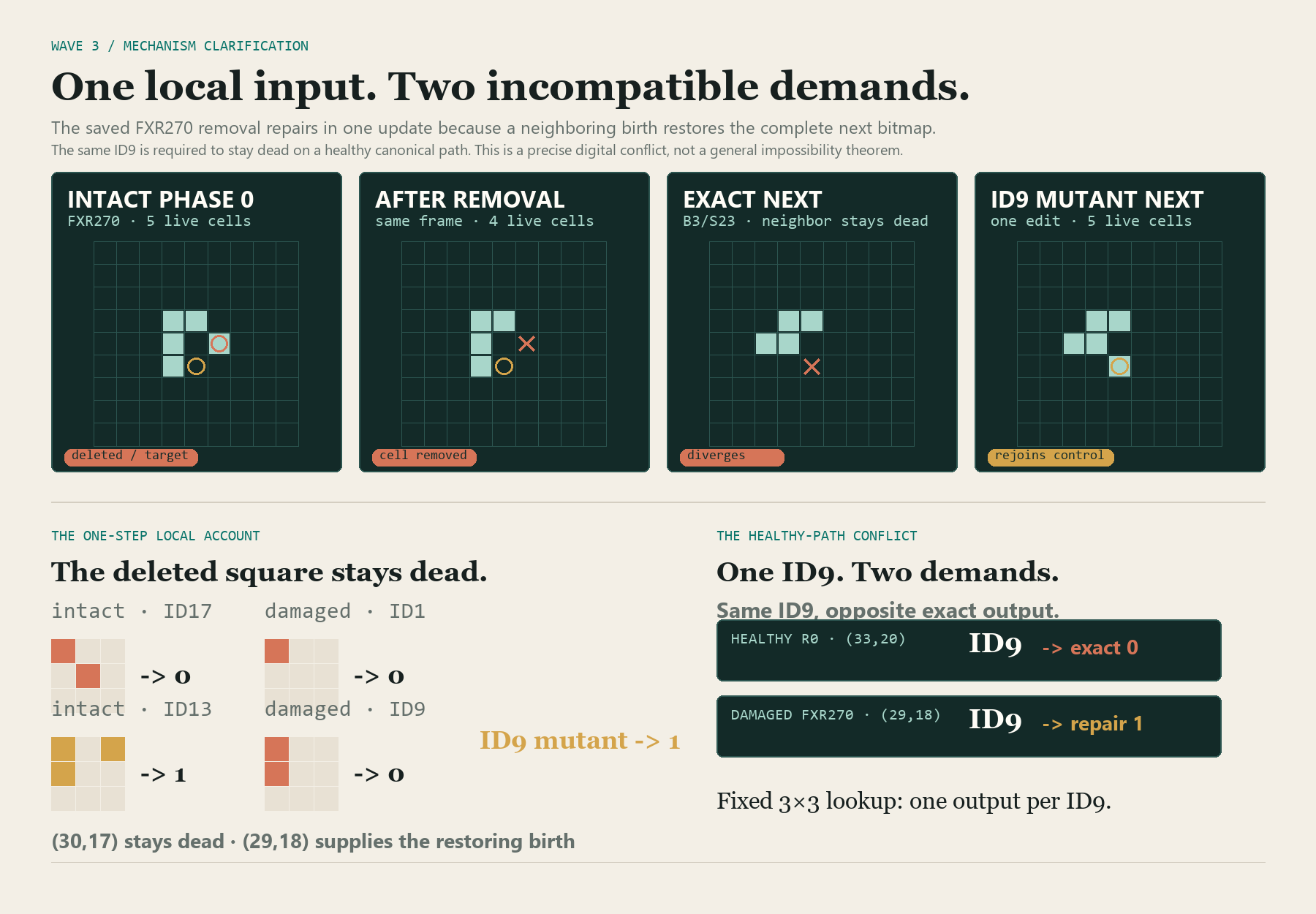
In the saved 64 × 40 experiment, a five-cell glider moves under the exact Conway B3/S23 table. At one declared damage point, one cell is deleted. The deleted cell stays dead.
The comparison uses that Conway baseline and an ID9-edited Conway table: a neighboring cell that should remain off in the damaged continuation becomes on under the edited table. That single birth makes the entire next bitmap equal the undamaged control.
Recovery requires every next-state cell to match the undamaged control, not merely a familiar live-cell count. A single local edit can restore a global trajectory; whether it helps depends on where that rule is encountered.
The same view can need opposite answers
The key neighborhood is recorded as ID9. On a healthy path, the correct output for ID9 is 0. At the damaged step, the repair needs that same local view to output 1 so the neighboring birth restores the next whole bitmap.
A memoryless 3 × 3 lookup table cannot encode both histories at once. It can choose one answer, or a larger state representation can carry a target, phase, or other context. This paper tests the narrow digital case; it does not claim that a biological system or an AI has been reproduced.
What was actually frozen
The Jev artifact in this study is a recorded table, not a live call inside the simulation. The raw table matches 231 of 512 binary neighborhoods. A separate count-based control matches 18 of 18 center/count cases, and expanding those cases produces the same exact Conway table.
Those figures describe this frozen recording and exhaustive local comparison; they are not a benchmark or measure of current model quality. Replay and repair make zero new provider calls.
A 16-case Jev qualification selected 8 complement and 8 Boolean-gate choices; deterministic code proves the identities, not Jev or universality.
The matched recovery census compares declared edits on the same saved trajectories. At 64 synchronous updates after damage, the exact rule recovers 8 of 200 matched cases; the ID9 repair recovers 10 of 200. Exact recovery shares eight cases; repair adds two removals.
The labels include phase and site aliases, so they are not 200 independent random samples. They are a finite, reproducible comparison of a declared intervention.
Why Michael Levin is part of the framing
Michael Levin’s 2019 discussion of developmental bioelectricity and scale-free cognition is conceptual inspiration for asking how state, memory, and a larger target might be represented. It is a biological source, not evidence that this cellular automaton has cognition or regeneration.
Alan Turing’s 1952 morphogenesis paper supplies historical context for pattern formation from local interactions. Stephen Wolfram’s cellular-automaton work and official Rule 110 documentation keep the computational question grounded in simple rules with complex consequences. The links below are sources for framing, not endorsements of this experiment.
A lab with an explicit upper bound
The offline companion lab lets a reader switch between a Conway control, a stored-target repair, an illustrative B23/S23 local rule variant, and the actual embedded 512-row offline Jev replay.
The stored-target mode is a privileged upper bound: it is given the target state by construction, so it demonstrates what extra information could buy rather than proving that the local rule discovered memory. The lab has no provider call, no credential, and no biological claim. Its evidence JSON keeps the measured values and their limits visible.
A persistent-memory extension is a proposal for a future experiment, not a result here. We did not run a hidden state, train a new model, or claim that a digital target is a morphogenetic target. The useful next step would be a held-out protocol that declares its context representation and tests it across orientations and seeds before looking at outcomes.
Sources and limits
This is a finite digital study of a frozen recording, fixed edits, and saved state comparisons. It does not establish biological regeneration, cognition, a universal Jev property, or a new Rule 30 or morphogenesis result. The paper, lab, evidence JSON, and replay are auditable; generated cover art is illustrative.
- Michael Levin, 2019: The Computational Boundary of a “Self”.
- Alan Turing, 1952: The Chemical Basis of Morphogenesis.
- Stephen Wolfram, 1984: Universality and Complexity in Cellular Automata.
- Wolfram's official Rule 110 documentation.
- The original eR33t Life rule-repair note.
- Open the offline memory/recovery lab.
- Download the wave-3 evidence JSON.
Authored by Justin Hedge, with AI-assisted preparation by AlexAI and Codex. The cover is an illustrative editorial image; computed claims remain tied to the saved experiment artifacts.
Rule atlas
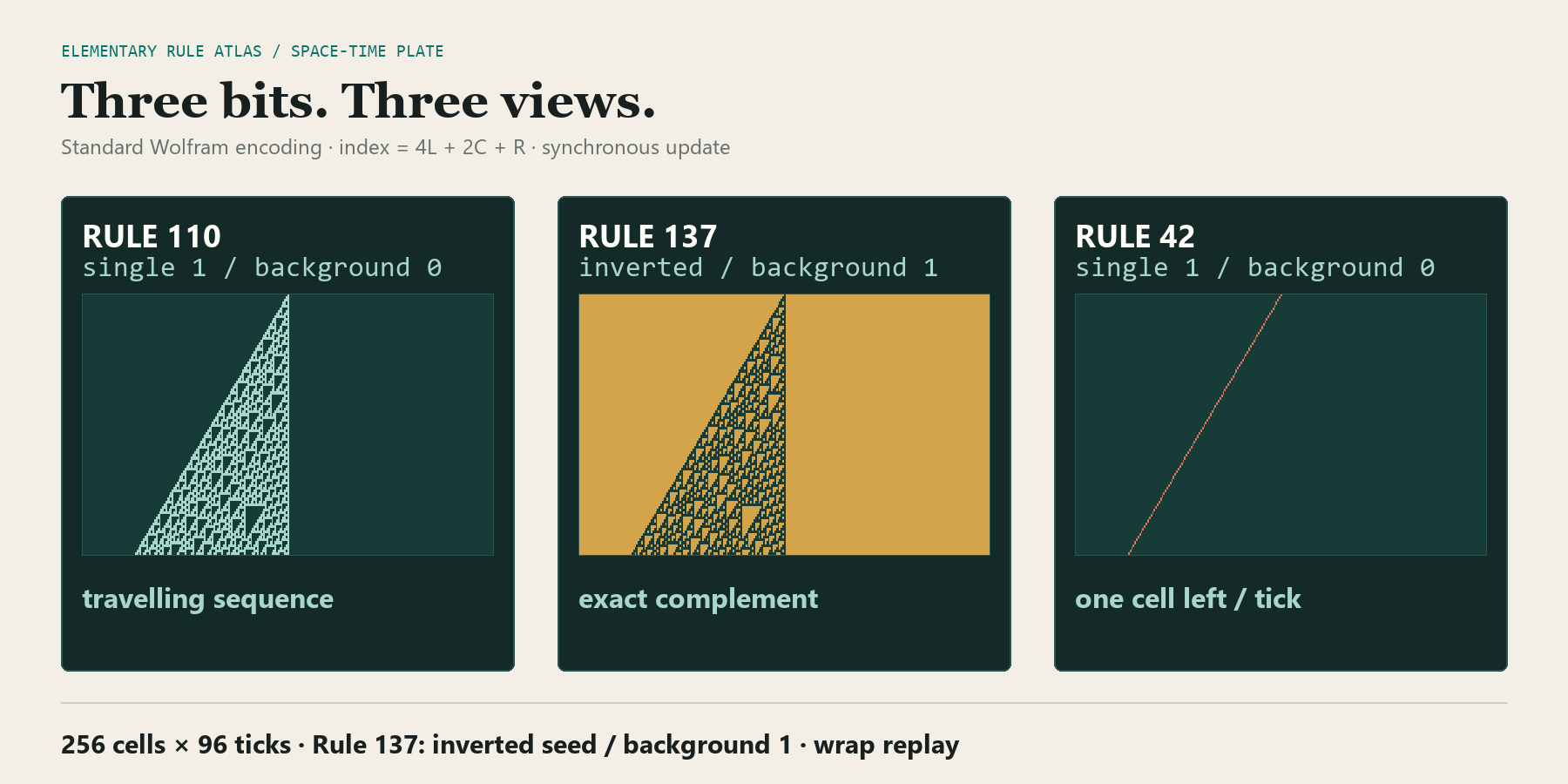
Rule 137 is Rule 110’s color conjugate; Rule 42 gets a Boolean wink. This atlas makes no universality claim. Open the atlas.
Evidence boundary. The table is a recorded artifact and the lab is an offline digital replay. Levin supplies conceptual biological inspiration only; this page makes no cognition, regeneration, or endorsement claim.